Don't start without a strategy
A logo is not the most important thing in your branding. Yet most clients spend 80% of their energy on exactly that — the shade, the shape, whether the line should be thick or thin.
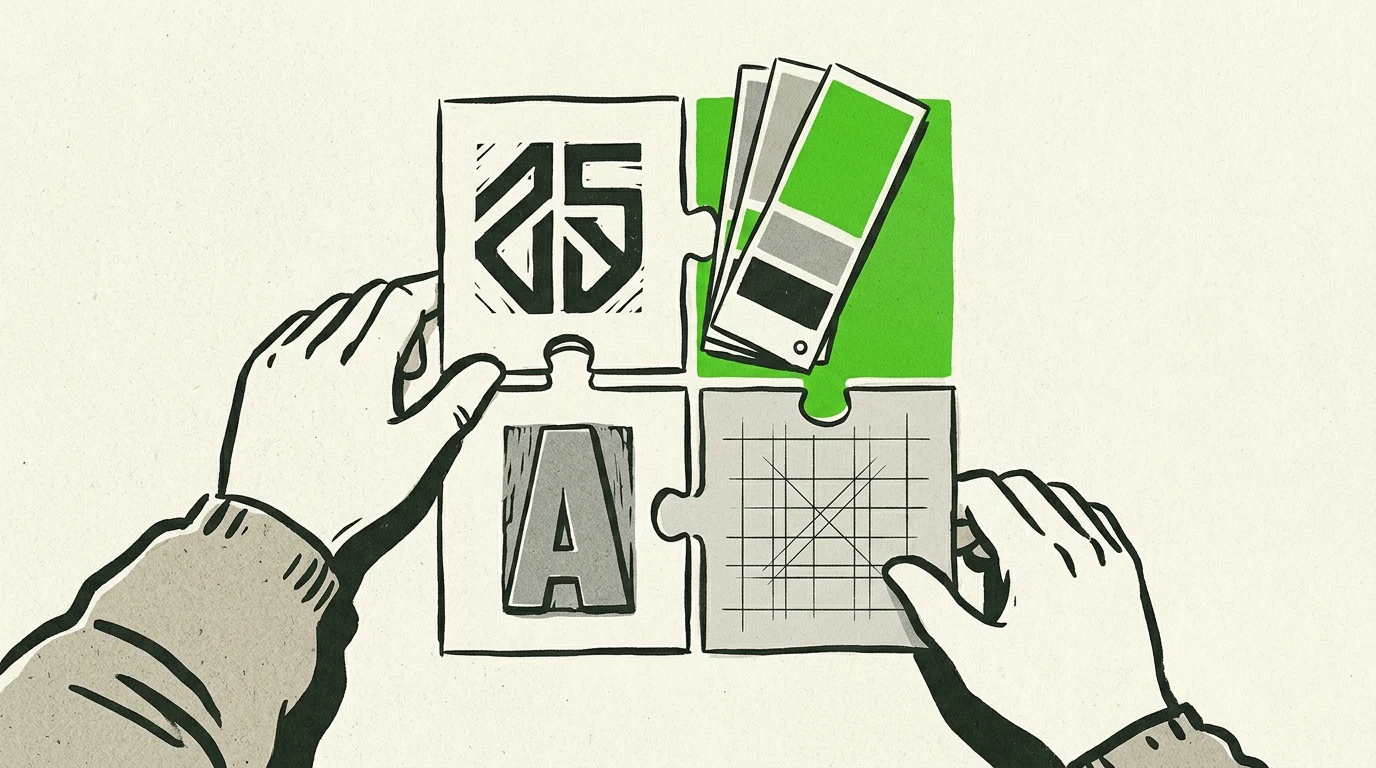
What matters more is everything around the logo: how the entire visual communication system works together. Colors, typography, photography style, tone of voice, layouts — these are what determine whether the market sees you as a leader or just another company in the crowd.
And yes — if you don't have the budget for a complete identity right now, that's fine. A well-thought-out business with modest visuals will always outperform a beautiful identity with no commercial foundation. Just be aware of one thing: a rebrand is coming down the line. And it will cost more than doing it right from the start. That's not a criticism — it's just a fact worth planning for.
A logo is a visual translation of who you are. If you can't articulate that clearly and quickly, no designer will figure it out for you. They can draw a shape. They can pick a color. But they cannot create an identity where none exists.
Before your first meeting with an agency, answer three things:
- Why should a customer choose you over the competition — and not because of price
- Who exactly is that customer and what keeps them up at night
- How do you want them to feel when they encounter you for the first time
If you don't have answers to these questions, that's the first thing to work on. Not the logo.
A good brief is half the work. Most clients don't have one.
"We want something clean, modern, premium." That's what we receive most often. And it's not enough.
Everyone wants clean, modern, premium. The problem is that everyone means something different by it — and without specific references, competitive analysis, and a clear understanding of the target audience, the designer works on instinct. And the result reflects that.
A good brief includes: who your competitors are and how you differ, visual references (what you want and what you don't), a realistic budget, and a realistic deadline. Not the optimistic one — the realistic one.
A good agency will help you work through this — that's part of what you're paying for. Just be aware that time spent on discovery and strategy always reflects in the price. The better prepared you are, the more efficiently you can work together. And it goes both ways: in this relationship, you are the expert in your industry. You know your customers, your competition, and your market better than anyone else. The agency brings expertise in visual communication — you bring expertise in your business. The best results happen when both sides contribute what they're genuinely good at.
A logo without a manual is a wasted investment
Here's the uncomfortable truth most agencies won't tell you: one logo isn't enough.
Without a color system, typography rules, and a brand manual, you have a file in AI (Adobe Illustrator) that someone will misuse within a year. A different shade here, a different font there — and the identity gradually falls apart into incoherent noise that customers instinctively read as unreliability.
A visual identity is a system. It needs to work on a business card and in a mobile app. On a website and at a trade show. In the hands of your in-house designer and a print supplier who's never seen your brand before.
If an agency hands you just a logo without rules for how to use it — you've received a half-finished product, not an identity.
Your feedback either moves things forward or blocks them
"I don't like that blue" — that's not feedback. That's a feeling.
"This feels too playful — our clients are CFOs looking for credibility and solidity" — that's feedback. We can work with that.
The more you anchor your evaluation in business reality — who your customer is, what they expect from you, what your competitors are doing — the more precise the result will be. A designer is not a mind reader. They're a professional who needs the right inputs to produce the right outputs.
A cheap logo will cost you more
This isn't an opinion. It's math.
You invest €120 in a logo on Fiverr. A year later you discover it doesn't look right on the web, print doesn't work, customers don't remember you, and you're doing the whole thing again — this time for example for €3,500. Plus a year of lost credibility.
Or you do it once, properly, with strategy behind it. An identity that doesn't just look premium but actually sells — a silent salesperson working for you while you're doing nothing.
That's the difference between a cost and an investment.
We're ready to build your brand
At CREAD Digital, we don't start with a project. We start with questions — deep ones, sometimes uncomfortable — because that's the only way to build an identity that holds up in the market.
If you want a brand that means something and generates results, get in touch. We'll take the first step together.